PV curtailment despite battery storage: causes, examples and proper design
Dec 17, 2025
Many industrial and commercial enterprises invest in PV systems and battery storage to utilize as much solar power as possible and to avoid feed-in restrictions. A storage system provides additional flexibility and can appropriately capture excess PV output. When this is achieved and in which situations feed-in restrictions are unavoidable even with storage will be explained below.
When is PV curtailed?
1. Curtailment due to negative electricity prices
In direct marketing, the compensation is based on the stock exchange electricity price. If this temporarily falls below zero, feeding in means: The plant operator pays money for the feed-in of electricity.
During such quarters, it is economically sensible to throttle the PV system.
Example from industry:
A production company feeds its PV system through direct marketing. On a sunny Sunday afternoon, the stock exchange prices are negative. Although the system could technically produce, part of the PV output is deliberately curtailed to avoid losses.
2. Curtailment due to grid feed-in limits
Regardless of the electricity price, many grid connections are technically limited.
Example:
PV system: 500 kWp
Grid connection allows max. 200 kW feed-in
On sunny days, the PV system can briefly generate more electricity than is allowed to be fed into the grid. Without additional consumers or storage, the excess part must be curtailed.
How does a battery storage help against curtailment?
A battery storage acts as a buffer between generation and consumption. It captures PV surpluses and shifts them temporally – for example, to the evening hours or during phases with positive electricity prices.
Example:
The company additionally installs a storage with
300 kWh capacity
150 kW charging power
At noon, most of the PV surplus flows into the battery instead of the grid. This significantly reduces both grid feed-in peaks and curtailment losses.
➡️ Important: The storage reduces curtailment – it does not guarantee that it disappears completely.
Why is PV still curtailed despite battery storage?
PV curtailment becomes unavoidable when three factors occur simultaneously:
High PV production
Grid feed-in limit is reached
Battery is full or limited in charging power
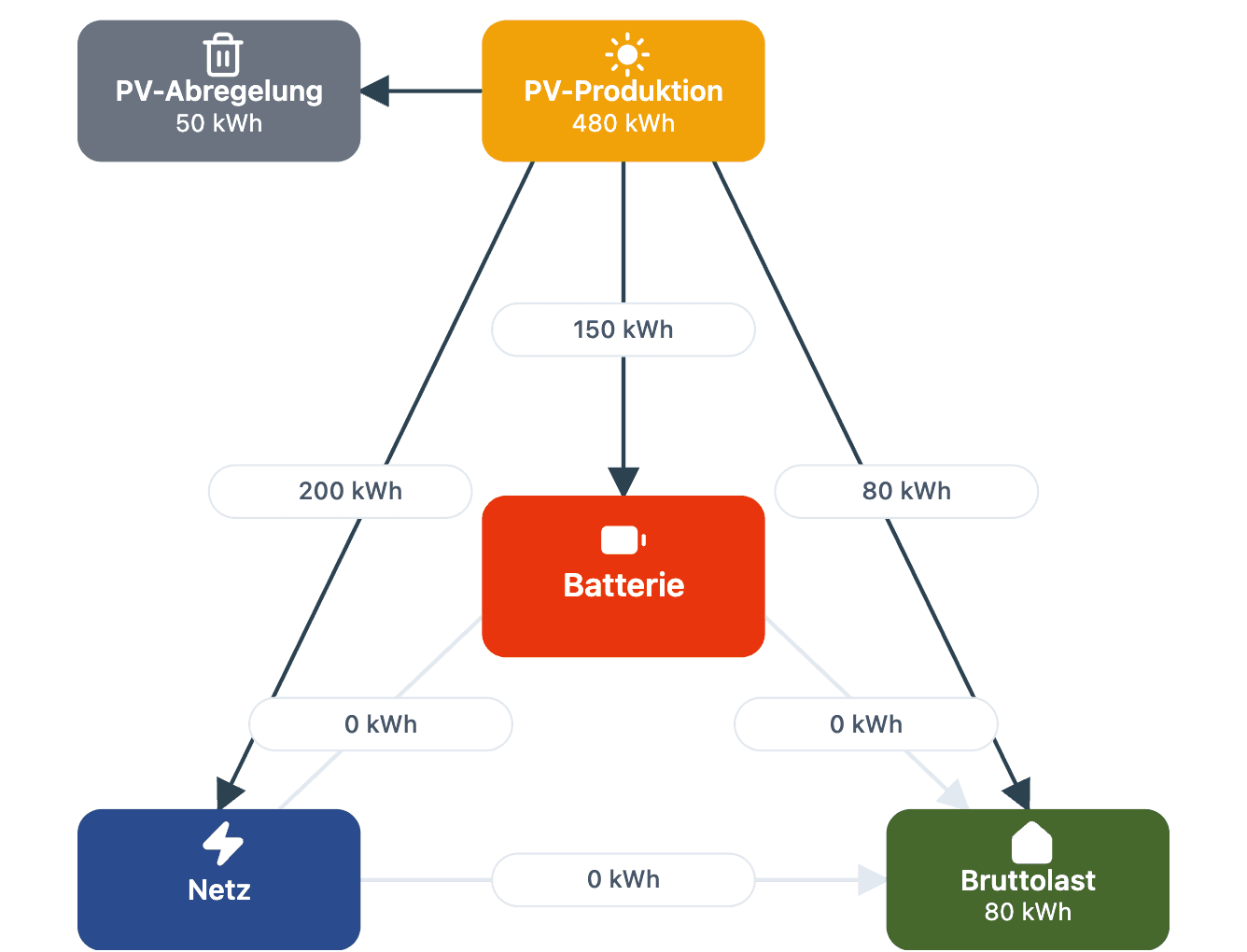
Concrete example:
PV production: 480 kW
Self-consumption in the company: 80 kW
Remaining surplus: 400 kW
Usable power:
Battery charges maximally with 150 kW
Grid takes in a maximum of 200 kW
➡️ Total usable: 350 kW
➡️ 50 kW remain and must be curtailed
Conclusion: Consider storage size carefully
A battery storage can significantly reduce PV curtailment in the industrial and commercial sector, but it cannot completely avoid it in every case. Especially with high PV peaks and limited grid connections, completely avoiding curtailment would often require a significantly larger storage.
Whether this additional storage size is economically worthwhile is not a given. High investment costs often face a relatively small reduction in the amount of curtailment. Therefore, PV curtailment should already be realistically considered in planning and design.
A good system design does not aim to avoid every kilowatt-hour of curtailment, but rather to find the economically sensible optimum between PV output, storage size, and grid connection.