Forecast-based EMS vs. static EMS – why proactive energy management systems are increasingly defining the standard
Dec 16, 2025
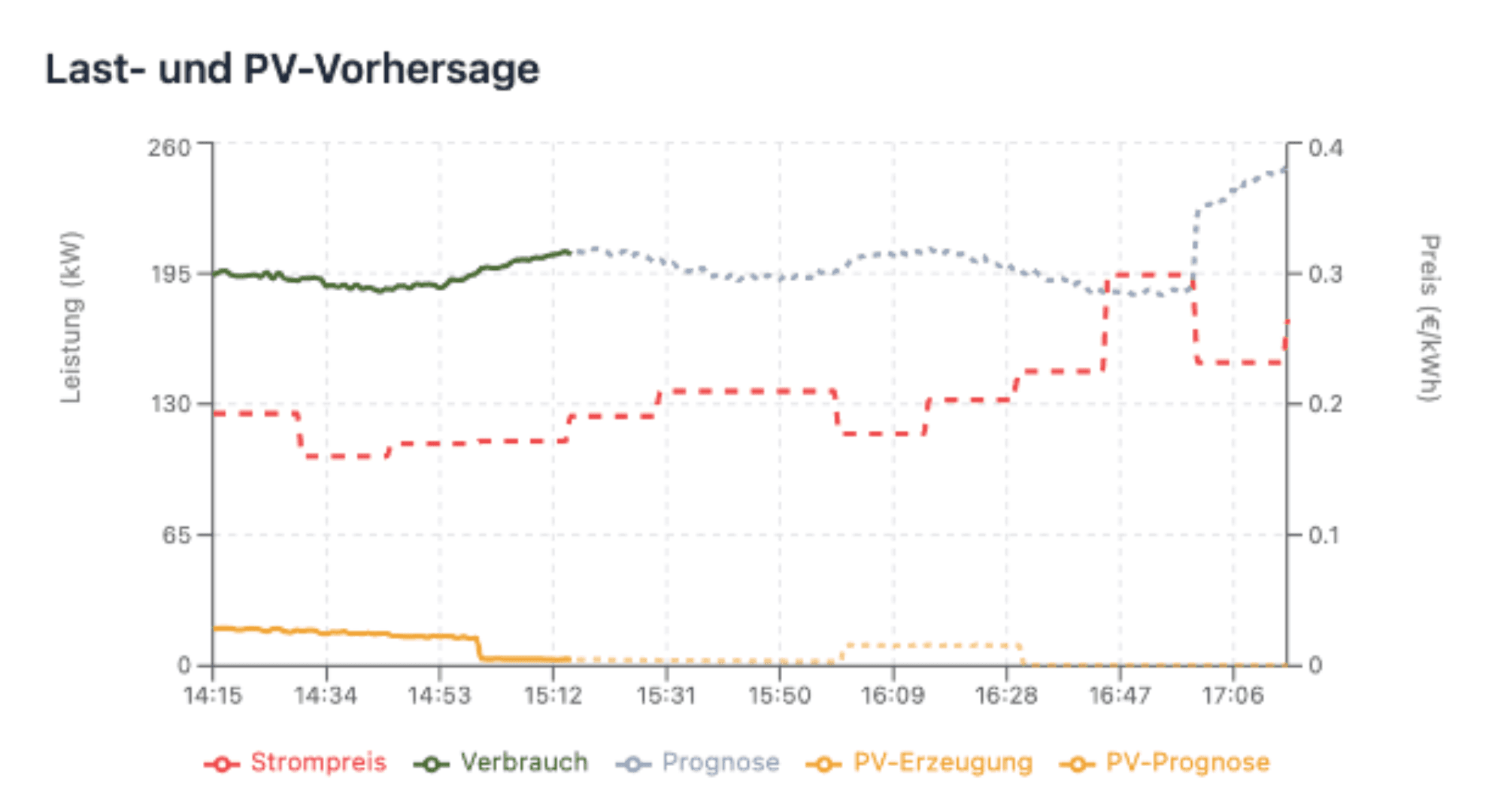
The economic efficiency of battery storage in commercial and industrial applications no longer primarily depends on the hardware, but is crucially determined by the quality of the energy management system (EMS) used, as it defines when, how strongly, and for what purpose a storage is charged or discharged, and thus directly influences revenues, cost savings, and aging effects.
In the market, two fundamentally different approaches have emerged: the static EMS, which is based on fixed rules and historical assumptions, and the forecast-based EMS, which anticipates future load, generation, and price signals and proactively optimizes its decisions.
1. What is a static EMS?
A static EMS follows predefined rules that are typically based on historical averages, fixed thresholds, or simple heuristics, such as the rule to charge the storage during the day with excess PV and discharge it in the evening to increase self-consumption or for peak load shedding.
These systems are relatively simple to implement, do not require complex forecasting models, and behave transparently from the user's perspective, but quickly reach their limits when load profiles, electricity prices, or regulatory conditions change, or when multiple applications need to be addressed simultaneously.
Typical characteristics of static EMS are:
Decisions based solely on the current system state
No explicit consideration of future loads, generation, or prices
Limited adaptability in volatile conditions
Fixed prioritization of individual application cases
The fixed prioritization of individual use cases often results in a static sizing and allocation of storage to individual operational strategies, so that, for example, the storage is reserved over the entire year for 20% for self-consumption optimization and 80% for peak load shedding, regardless of whether this allocation is actually economically sensible under changed load, price, or generation conditions. A forecast-based EMS is needed for a dynamic allocation of the storage that reacts, for example, to changing solar radiation (winter vs. summer).
2. What is a forecast-based EMS?
A forecast-based EMS extends this approach with an explicit look into the future, utilizing forecasts for relevant influencing factors such as electrical load, PV generation, electricity prices, or grid fees and deriving a time-optimized operating mode for the storage from them.
The core of the system is an optimization model that determines, based on the forecasts, which charging and discharging power is economically optimal at which time, whereby technical restrictions, degradation costs, and multiple revenue streams can be simultaneously taken into account.
Characteristic features of forecast-based EMS include:
Utilization of load, generation, and price forecasts
Time-linked optimization over several hours or days
Dynamic weighting and combination of multiple application cases
The forecasts for load, generation, and price data are today created using modern machine learning methods, with significant advancements in model architectures, data availability, and computing power in recent years leading to substantial improvements in forecasting accuracy, so that short-term and intraday predictions now achieve a quality that makes the economic use of forecast-based optimization methods practicable and scalable.
3. Economic differences in practical operation
The central advantage of a forecast-based EMS lies in its ability to resolve conflicts of objectives between different application cases, as, for example, an aggressive peak load shedding in the morning can prevent sufficient capacity for high electricity prices or ancillary services in the afternoon.
While a static EMS does not recognize such conflicts of objectives and potentially makes suboptimal decisions, a forecast-based EMS can consciously forgo short-term savings to achieve higher overall revenues in the long run.
In practice, this often leads to:
Better combinability of multiple application cases
Additional revenues from market and trading applications
Reduced battery aging through optimized cycle planning
More stable results over different weather and price years
4. Robustness in the face of uncertainty
A common argument against forecast-based systems is the inherent uncertainty of forecasts, especially with volatile PV generation or short-term price movements.
However, modern EMS address this issue through regular re-optimization, conservative constraints, and scenario analyses, so that forecast errors do not lead to systematic misdecisions but only fine-tune the optimal operating mode.
Static systems, on the other hand, respond robustly to forecast errors but are structurally incapable of taking advantage of price volatility or load shifting.
5. When is which approach sensible?
A static EMS can represent a cost-effective entry solution in very simple applications with clearly defined single-use cases and low volatility, such as in small PV storage systems focused solely on self-consumption optimization.
However, as soon as multiple revenue streams become relevant, a forecast-based EMS is practically necessary to fully exploit the economic potential of the storage.
6. Conclusion
The comparison between forecast-based and static EMS is ultimately not purely technical but an economic one, as the additional complexity of forecast-based systems is compensated by significantly higher and more stable returns.
For commercial and industrial companies that view battery storage as an active economic asset and not merely as a passive supplementary system, a forecast-based EMS increasingly represents the new standard.
Please feel free to book an appointment for suitable advice here: https://cal.com/lumeraenergy/ems