Update on MiSpeL corner points: Measurement procedures for verifying the demarcation option.
Sep 22, 2025
The Federal Network Agency published the key points for the market integration of storage and charging points (MiSpeL) for consultation on September 19, 2025. These drafts represent initial proposals that will be discussed in a workshop with the industry on October 1, 2025. The final determination may therefore deviate from the current key points. The new regulations aim to relax the previous restrictions on the use of PV storage combinations. Currently, operators must choose between EEG funding for stored solar power or the flexible use of the storage. The exclusivity option only allows the storage of self-generated electricity, while any grid connection for charging the storage ends all eligibility for funding. The MiSpeL key points propose two new options that should allow simultaneous use of EEG funding and levy advantages. This could open up new economic opportunities for PV storage operators, such as charging at low electricity prices and discharging at high prices. The consultation period runs until October 24, 2025. Subsequently, the Federal Network Agency will evaluate the received statements and develop the final determination.
What is the MiSpeL determination?
The market integration of storage and charging points (MiSpeL) is a planned determination by the Federal Network Agency based on the amendments to the Renewable Energy Sources Act (EEG) and the Energy Financing Act (EnFG) through the Electricity Peak Act. These legal changes have established the legal foundations for a more flexible use of electricity storage and bidirectional charging points.
The core problem lies in the current exclusivity option according to § 19 Abs. 3a EEG. While this does allow EEG funding for electricity from "pure EE storage", it simultaneously prohibits the storage of grid electricity. As soon as even once electricity from the grid is loaded into the storage, the entire eligibility for all subsequent feed-ins ceases. Conversely, the utilization of EEG funding excludes a levy balancing.
This strict separation leads in practice to storage being either completely blocked against grid electricity during charging or disconnected from grid feed-in during discharging. The Federal Network Agency notes that, as a result, "flexibility potentials of electricity storage and charging points have so far been utilized only to a very limited extent in practice and opportunities for an active response to market signals remain untapped." [1]
MiSpeL aims to resolve this blockage through two new options: the demarcation option for precise computational allocation and the flat-rate option for simplified flat-rate regulations. Both options should enable bidirectional storage use while partially maintaining funding and levy advantages.
The determination is intended to apply equally to new and existing plants. However, both new options require complete allocation to direct marketing. A combination with the classic feed-in remuneration is excluded. The flat-rate option is also subject to the condition of state aid approval by the European Commission.
The three options at a glance
The MiSpeL key points provide for three different marketing models from which plant operators can choose. Each option has specific characteristics, requirements, and application areas.
Exclusivity option (previous)
The established exclusivity option remains in its current form. It follows the principle of strict separation: either the storage is charged exclusively with self-generated EE electricity and receives full EEG funding for it, or it is used for other purposes and loses any eligibility for funding.
In practice, this usually requires a technical blocking of the storage either against grid electricity when charging or against grid feed-in when discharging. The advantage lies in simple billing and full funding for the fed-in electricity. The main disadvantage is the lack of flexibility: market reactions to price fluctuations and thus charging at low/discharging at high electricity prices are not possible.
This option continues to be suitable for operators who value simple structures and maximum planning security but relinquish extended optimization options.
Demarcation option (new)
The demarcation option allows completely flexible mixed operation but requires precise, computational evidence. Storage can be charged both with solar and grid electricity, while EEG funding and levy advantages remain proportionally intact.
The system is based on quarterly recording of all electricity flows and their mathematical allocation according to specified formulas. Two basic rules determine the allocation: concurrent grid electricity takes precedence during storage charging/consumption, concurrent storage generation takes precedence during grid feed-in.
Storage generation is the electricity that the battery storage discharges.
Storage consumption is the electricity that the battery stores (charges).
The demarcation option requires sophisticated measuring technology with several quarterly accurate meters and is available for all plant sizes. It offers maximum economic optimization but brings significant complexity in billing.
Flat-rate option (new)
The flat-rate option simplifies the allocation logic through flat-rate regulations but is limited to solar systems with a maximum of 30 kWp and requires state aid approval from the EU Commission.
The basic principle uses a fixed limit: For each kWp of installed solar capacity, a maximum of 500 kWh of grid feed-in per year is generally considered eligible for funding. If the actual feed-in is below this limit, it is fully eligible for funding. If it exceeds the limit, the surplus is considered a levied privileged "intermediate stored grid electricity" on a flat-rate basis.
The flat-rate option requires only a single bidirectional meter and avoids complex calculations. It is primarily aimed at typical prosumer households that would like to benefit from the simplification.
Demarcation option in detail - Summary
Core principle
The demarcation option enables the flexible, bidirectional use of electricity storage and charging points with EE systems through mathematically precise allocation of electricity flows based on quarterly measured values.
Main advantages over the previous exclusivity option
Mixed operation possible: Electricity storage can charge both EE electricity and grid electricity
Bidirectional charging points: Electric vehicles can act as storage
Parallel privileges: EEG funding and levy balancing can be used simultaneously
Market orientation: Charging at low prices, discharging at high prices
Central allocation rules (legally prescribed)
Storage consumption: Concurrent grid electricity takes precedence over EE electricity during charging
Grid feed-in: Concurrent storage generation takes precedence over direct EE feed-in
Calculation of shares (Core formulas)
Grid electricity share for the year:
Grid electricity share = Sum of concurrent grid electricity consumption / Total consumption in storage
Eligible grid feed-in:
Eligible = Grid electricity share × Sum of concurrent storage feed-in
Funded grid feed-in:
EE electricity share = (100% - Grid electricity share) Funded = EE electricity share × Storage feed-in during AW>0 times + Direct EE feed-in during AW>0 times
Detailed calculations
For an accurate calculation with all formulas and practical examples, an interactive Google Sheet is available under the following link. The input values can be adjusted to simulate various scenarios and understand the impacts on funding and levy privileges: https://docs.google.com/spreadsheets/d/1B17LnAejtV2epoKLl6zyqYW1TtS0c2Yp7Mvwhcyc0I8/edit?usp=sharing

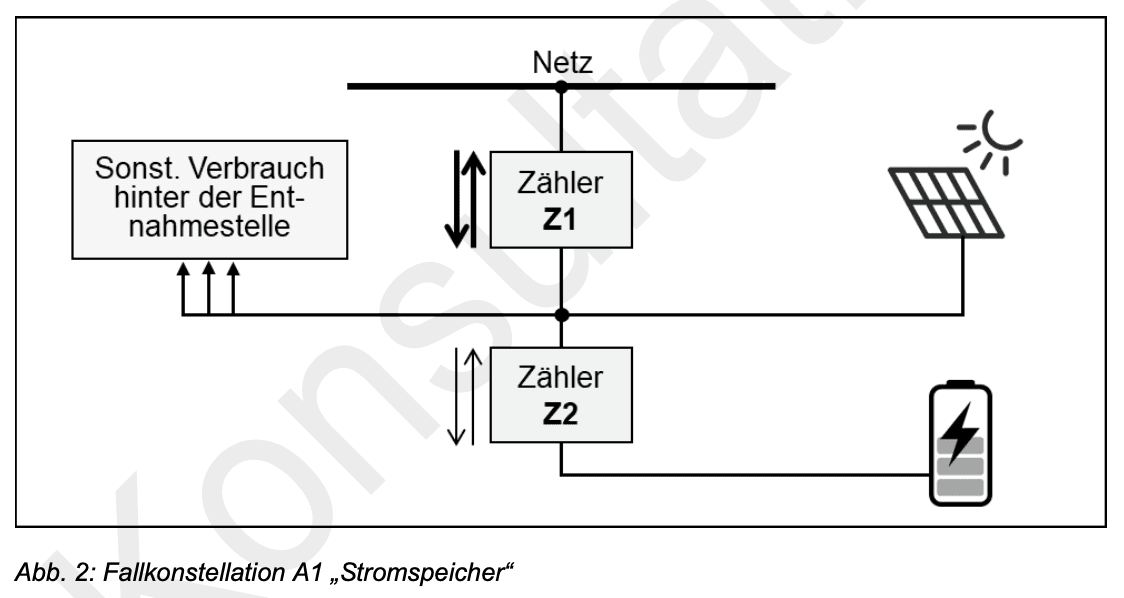
Measurement requirements in case A1
The demarcation option requires at least two quarterly accurate bidirectional meters:
Z1: Recording of grid consumption and grid feed-in
Z2: Recording of storage consumption and storage generation
For the separate recording of privileged storage losses, a third meter may be required. All measurements must be carried out in compliance with measurement and calibration law in quarterly resolution.
The demarcation option allows maximum flexibility in storage management but requires significant technical and administrative effort. It is particularly suitable for larger plants and operators who want to fully exploit their optimization potential.
[1] Consultation: https://www.bundesnetzagentur.de/DE/Fachthemen/ElektrizitaetundGas/ErneuerbareEnergien/EEG_Aufsicht/MiSpeL/DL/Konsultation.html?nn=1067830